What is a bone graft?
A bone graft restores the volume needed for an implant to hold. It does not replace the implant; it prepares its support.
During the procedure, graft material is positioned over the deficient area, sometimes protected by a membrane that keeps soft tissue out while it is being colonised.
A healing phase of several months then lets the bone regenerate and reach sufficient density. Only at the end of that period, checked on imaging, is placement considered.
It is never automatic: it is proposed only when the volume available is not enough to hold an implant steady.
How we work
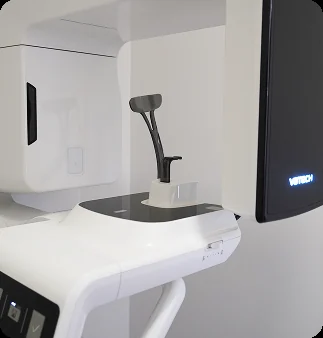
The need for a graft is not judged by eye, nor on a flat radiograph. It is measured on three-dimensional imaging, which gives the height and thickness of bone actually available, along with the structures to respect.
That same measurement determines whether the graft can be done during implant placement, saving a procedure and several months of waiting, or whether it must come first.
Why bone goes missing
Several causes lead to insufficient volume, and they do not all call for the same answer.
- A tooth missing for a long time: with the bone no longer used, it gradually resorbs.
- An old extraction carried out without preserving the volume.
- Gum disease that has destroyed the supporting bone.
- In the upper jaw, a descended maxillary sinus, which limits the height available.
When a graft is not the answer
It is neither automatic nor always desirable.
- Bone volume already sufficient: the measurement says so, and a graft then has no place.
- Active infection at the site, to be treated before any reconstruction.
- Heavy smoking, which compromises the graft taking as much as the implant.
- Certain general medical situations, calling for specific advice before any procedure.
When a graft is set aside, other routes exist: shorter implants, a different anchor position, or a solution that does not rely on that area.
Bone graft or sinus lift?
Both rebuild volume, but not in the same place nor in the same way. The term sinus lift names a variant, not a separate discipline.
| Bone graft | Sinus lift | |
|---|---|---|
| Where | On the bony ridge, in height or thickness | Under the floor of the maxillary sinus |
| Jaw | Upper or lower | Upper only, molar region |
| Principle | Add material over the deficient area | Lift the sinus membrane and fill the space created |
| With placement | Sometimes during, sometimes before | Often during, if residual height allows |
The choice is dictated by anatomy, not preference: the imaging shows which of the two, or both, is called for.
How the procedure unfolds
The surgery fits into one session. It is the regeneration of the bone that takes time, and it is not hurried.
1. Assessment and measurement
Full clinical examination and three-dimensional imaging, which define the area to treat and the volume to rebuild.
2. The procedure
Under local anaesthetic, graft material is positioned over the deficient area, sometimes protected by a membrane.
3. Healing
Several months during which the bone regenerates and becomes denser. This phase cannot be shortened.
4. Checking the volume obtained
New imaging confirms that the volume and density reached allow the implant to be placed.
5. Placing the implant
Implant treatment then resumes its normal course, on a rebuilt support.
What follows
Swelling and tenderness are expected in the following days, more marked than after a simple implant placement. They are controlled by the painkillers prescribed.
Written aftercare instructions set out what to avoid during healing: blowing the nose forcefully after a sinus lift, for instance, or chewing on the operated side.
A light nosebleed in the days following a sinus lift is not abnormal. A heavy or persistent one is.
Does grafted bone last?
Once colonised by the patient’s own bone, the rebuilt volume behaves as bone. It holds as long as it is used, that is, as soon as an implant transmits chewing forces through it.
That is also why a graft is done with a placement in view, and not for its own sake: rebuilt bone that nothing uses eventually resorbs like the first.
What does a bone graft cost?
The cost depends on the extent of the area, on the material used and on whether a membrane is needed. A sinus lift and a thickness graft are not the same procedure.
The graft appears in the written estimate given after the assessment, alongside the implant treatment it belongs to. It is not reimbursed by Assurance Maladie; some complementary insurers contribute.
 or by phone