What is an implant-supported bridge?
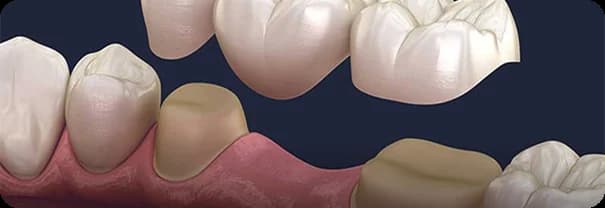
An implant-supported bridge replaces several adjacent teeth by resting on implants placed in the bone, not on the remaining teeth.
The principle fits in a sentence: it needs fewer implants than teeth replaced. Two implants can carry three teeth, the middle element simply spanning between the two anchors.
That is what sets it apart from placing one implant per tooth: fewer procedures, fewer healing sites, and a cost that does not rise in step with the number of teeth.
Not to be confused with a traditional bridge, which rests on the neighbouring teeth and requires reducing them.
How we work
The number and position of the supporting implants are not decided in the chair. They come from three-dimensional imaging, according to the bone available at each point of the arch — which is not the same everywhere.
An implant placed where the bone is thickest holds better than one placed where the tooth used to be. That often explains why a bridge does not sit exactly under the teeth it replaces.
When does it apply?
An implant-supported bridge suits people who have lost several adjacent teeth and want a fixed solution.
- Three or four adjacent teeth missing in the same area.
- A back section with no teeth, where chewing is at stake.
- A partial removable denture found uncomfortable or unstable.
- Enough bone at a minimum of two anchor positions.
When it does not apply
Some situations point to another solution, or require a preliminary stage.
- Insufficient bone at the anchor positions, until a graft has been carried out.
- Active gum disease, to be treated first.
- Missing teeth that are not adjacent: individual implants are often better suited.
- A fully edentulous arch, which calls for a full-arch restoration.
A bridge that is too long, carried by too few implants, tires its anchors. That is a mechanical limit, and it is what the treatment plan arbitrates.
Bridge on implants or one implant per tooth?
For three adjacent missing teeth, two strategies exist. They do not cost the same and they are not maintained the same way.
| Bridge on implants | One implant per tooth | |
|---|---|---|
| Implants needed | Two, for three teeth | Three, for three teeth |
| Surgical sites | Fewer | One per tooth replaced |
| Bone required | At the anchor positions only | Under each tooth replaced |
| Cleaning | Under the middle element, with a suitable floss | Between each crown, as for teeth |
| If something goes wrong | The whole bridge is involved | Only one tooth is involved |
The choice depends on the bone available, on the length of the gap and on what you are willing to maintain day to day. It is discussed at the assessment.
How treatment unfolds
The timetable is that of a single implant: the healing of the bone sets the duration, not the number of appointments.
1. Consultation and imaging
Thorough examination, radiographs and three-dimensional imaging, which determine the number and position of the supporting implants.
2. Placing the implants
The supporting implants are placed in the bone under local anaesthetic, guided by the plan drawn up on the image.
3. Healing
The bone bonds to the implants. A temporary solution can be planned for that period.
4. Fitting the bridge
Impression, fabrication, then fitting of the final bridge onto the implants, and adjustment of the bite.
5. Follow-up
Regular check-ups confirm the stability of the anchors and the health of the gum around each implant.
What follows
As for a single implant, the procedure is done under local anaesthetic. Swelling and tenderness may appear in the following days, controlled by the painkillers prescribed.
Getting used to a fixed bridge is generally quick: nothing comes out, nothing moves. The adjustment is mostly about cleaning, which asks for a new habit under the middle element.
Longevity and upkeep
An implant-supported bridge is built to last. Its longevity rests first on the health of the gums around its anchors, therefore on daily hygiene and on check-ups.
The point to watch is the space under the middle element, which brushing alone does not reach. A suitable floss or an interdental brush is enough, and the technique is shown at the practice when the bridge is fitted.
What does an implant-supported bridge cost?
The cost depends on the number of supporting implants, on the material of the bridge and on whether a graft is needed beforehand. Per tooth replaced, it is generally lower than one implant per tooth, since fewer are needed.
A detailed written estimate is given after the assessment. Implants are not reimbursed by Assurance Maladie; the prosthetic part may be partly covered, and many complementary insurers offer a fixed allowance.
 or by phone