What is a dental implant?
An implant replaces the root of the tooth, not the whole tooth. That distinction explains everything else: the length of treatment, the cost, and why the neighbouring teeth need not be touched.
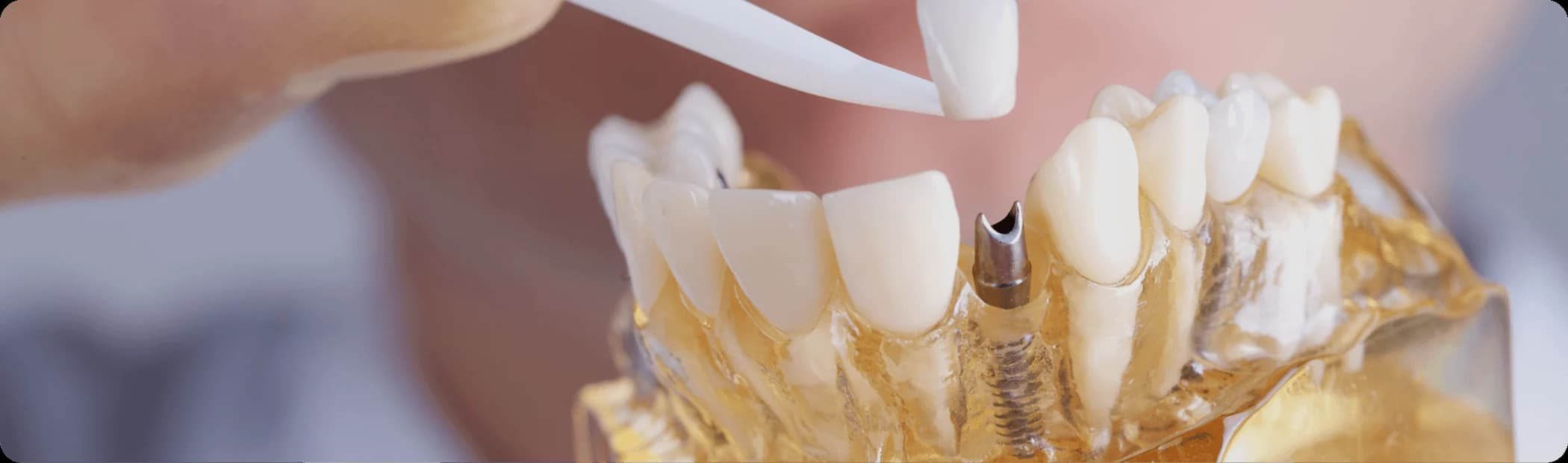
The implant is an artificial root, in titanium or ceramic, placed in the jawbone. What you then see, the crown, is fixed to it through a part called the abutment. Three components, only one of which is visible.
Once placed, the bone gradually bonds to the implant. That process has a name, osseointegration, and it is what gives the whole assembly its stability. Until it is complete, the final tooth cannot be fitted.
Unlike a removable appliance, an implant is fixed and rests directly on the bone. It leans neither on the gum nor on the remaining teeth.
How we work
Nothing is discovered on the day of surgery. Three-dimensional imaging, taken at the practice, measures the bone available and locates the nerves and sinuses before the procedure. The plan is settled on that image, not in the chair.
A surgical guide then transfers that plan into the mouth, including angle and depth. This is what guided surgery means: it turns a matter of judgement into a repeatable act.
The written estimate is given after the assessment and before any decision. You take it away with you, and nothing starts until you have accepted it.
When is an implant placed?
Implants are for people who have lost one or several teeth and who have enough bone, or bone that can be rebuilt.
- A missing tooth to replace without touching healthy neighbouring teeth.
- A tooth beyond saving, to be extracted and then replaced.
- Several missing teeth, adjacent or not.
- An unstable removable denture, to stabilise or replace.
When an implant is not the answer
There are situations where placement is inadvisable, postponed, or replaced by another solution. Setting them out is not a formality: it is what the assessment exists to establish.
- Insufficient bone, until a graft has rebuilt the support needed.
- Active gum disease, which must be treated before any placement.
- Heavy smoking, which markedly raises the risk of osseointegration failing.
- Uncontrolled diabetes, or certain general conditions and medical treatments requiring specific advice.
- Bone growth not yet complete, in adolescents.
Several of these are temporary. A gum can be treated, diabetes can be brought under control, bone can be rebuilt: the question is then not whether, but when.
Implant or traditional bridge?
This is the comparison we are asked about most. Both replace a missing tooth, but they do not rest on the same thing, and it is that difference which decides.
| Implant | Traditional bridge | |
|---|---|---|
| Rests on | The jawbone | The two neighbouring teeth |
| Neighbouring teeth | Intact, untouched | Reduced to carry the bridge |
| Bone under the gap | Used again | Unused, it keeps resorbing |
| Length of treatment | Several weeks to a few months | A few appointments |
| Prerequisite | Enough bone, or bone that can be rebuilt | Neighbouring teeth able to carry |
A bridge keeps its place when the neighbouring teeth are already crowned or weakened: they will be restored in any case. The choice is made case by case, after examination.
How placement unfolds
The longest stage is also the quietest: healing, during which the bone bonds to the implant. It asks for nothing but time.
1. Consultation and assessment
Clinical examination, three-dimensional imaging, assessment of bone volume and gum health. The treatment plan and the written estimate follow from it.
2. Placing the implant
Under local anaesthetic, after a small incision in the gum, the implant is inserted into the bone following the plan carried by the guide. Aftercare instructions are given on the day.
3. Osseointegration
The bone bonds to the implant. This phase usually runs four to six months. A temporary tooth can be planned for that period.
4. Fitting the crown
Once the implant is stable, an impression is taken, the crown is made, then fitted on the abutment and adjusted.
5. Follow-up
Regular check-ups confirm the stability of the implant, the health of the surrounding gum and the fit of the crown.
What follows the procedure
The procedure itself is done under local anaesthetic and is not painful. Moderate after-effects may appear in the following days: swelling, tenderness in the area, sometimes slight bruising.
They are usually well controlled by the painkillers prescribed, and written aftercare instructions go with you. Brushing resumes normally, avoiding the operated area for the time indicated.
Pain that increases rather than eases after a few days is not a normal after-effect. That is the moment to call the practice, not to wait.
Longevity and upkeep
An implant is designed to last and can stay functional for many years. Its longevity depends on daily hygiene, on regular follow-up, on not smoking and on the health of the gums.
Upkeep is that of a tooth: brushing twice a day, cleaning between the teeth, regular check-ups. What surrounds the implant stays alive, and inflammation can set in there painlessly at first, which is exactly what check-ups look for.
The crown is a wearing part. It may need replacing over time, without the implant carrying it being called into question.
What does a dental implant cost?
The cost depends on the type of implant used, on whether a bone graft is needed beforehand and on the type of crown chosen. Two situations that look alike from the outside can call for very different work: no general figure means anything here.
A personalised, itemised estimate is given at the consultation, after the assessment and the imaging. The implant itself is not reimbursed by Assurance Maladie, the French state health insurance; the crown may be partly covered, and many complementary insurers offer a fixed allowance.
 or by phone