What is a full-arch restoration?
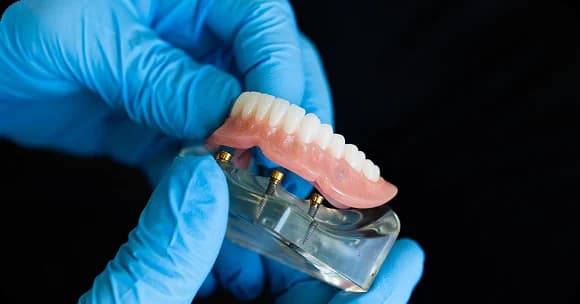
An entire arch restored on a reduced number of implants, generally four to six, carrying a fixed prosthesis.
The protocols known as All-on-4 and All-on-6 rest on four or six implants respectively. The number chosen depends on the bone available and how it is spread, not on doctrine.
The implants are not placed under each tooth replaced: they are distributed where the bone is most favourable, sometimes angled to avoid a deficient area and gain a firmer anchorage.
The prosthesis is fixed. It does not come out, does not rest on the gum and needs no adhesive.
How we work
A whole arch is not planned tooth by tooth. Three-dimensional imaging is used here to find, across the whole jaw, the few positions where the bone offers the best anchorage — often at the front, where it resorbs less.
That is what makes it possible, in many cases, to avoid a graft: rather than rebuilding bone where it is missing, we anchor where it remains.
Who is it for?
It applies where an arch can no longer be kept tooth by tooth.
- A fully edentulous jaw, upper or lower.
- Remaining teeth too damaged to be kept.
- A complete removable denture found uncomfortable, unstable or poorly tolerated.
- Chewing that has become difficult, with the dietary consequences that follow.
When it does not apply
A full-arch restoration is not the only answer to missing teeth, and it does not suit every situation.
- Teeth still worth keeping: extracting them to place implants would be a loss, not a gain.
- Insufficient bone at every conceivable anchor position.
- Active gum disease, to be treated before any procedure.
- General medical situations calling for specific advice, or heavy smoking not reduced.
A removable denture stabilised on two implants is a lighter and often less costly alternative. It deserves to be compared, not dismissed.
Fixed prosthesis or removable on implants?
Two ways to restore an arch on implants. They need neither the same number of anchors nor the same upkeep.
| Fixed prosthesis | Removable on implants | |
|---|---|---|
| Implants needed | Four to six, depending on bone | Two to four |
| Comes out | No, only by the practitioner | Yes, by the patient, for cleaning |
| Rests on the gum | Not at all | Partly |
| Cleaning | In the mouth, with suitable tools | Out of the mouth, simpler |
| Sensation | Close to fixed teeth | Stable, but removable |
Removable on implants is often underrated. It restores real stability for someone who tolerates a conventional denture badly, for fewer implants and a lower cost.
How treatment unfolds
Treatment is longer than a single placement, but it often includes a stage the others do not: a temporary prosthesis fitted very early.
1. Full assessment
Consultation, three-dimensional radiological examination and planning of implant positions across the whole arch.
2. Placing the implants
The implants are placed following a suitable surgical protocol, at the positions chosen on the image.
3. Temporary prosthesis
In many cases a temporary prosthesis is fitted soon after the procedure, restoring chewing and appearance without waiting.
4. Osseointegration
The implants bond to the bone. The temporary prosthesis accompanies that period.
5. Final prosthesis
Fitted once healing has been confirmed, with adjustment of the bite across the whole arch.
What follows
The procedure is more extensive than a single placement, and so is what follows: swelling, tenderness, sometimes bruising. It lasts a few days and is controlled by the painkillers prescribed.
Diet is adapted during healing, soft at first, then gradually normal. Written instructions set out the timetable.
Longevity and upkeep
A full arch on implants is built to last, provided the gums around each anchor stay healthy. That is where its longevity is decided, not in the prosthesis itself.
Cleaning calls for suitable tools: interdental brushes, a specific floss, often a water flosser. The technique is taught at the practice, and regular check-ups confirm it remains effective.
The prosthesis may need replacing over time, without the implants being called into question.
What does a full-arch restoration cost?
It is the most extensive implant treatment, and its cost depends on the number of implants, on the material of the prosthesis, on whether an immediate temporary is fitted and on any extractions.
The written estimate itemises each procedure separately, which lets you send it to your insurer and discuss it item by item. No figure is announced before the assessment.
 or by phone